Corrections
Correction of the ignition advance by engine temp
On a cold engine, the ignition angle can be higher than on a warm one. As a rule of thumb, above 60 degrees, the correction should be 0. Below 60 degrees, the correction gradually increases, and at a temperature below zero it can reach +5..10 degrees
Correction of the ignition advance by charge temp
As the temperature of the inlet charge increases, the knock probability increases. So it needs less advance.
As the temperature of the inlet charge decreases, the air-fuel charge become dense. So it needs less advance.
Crankshaft acceleration correction
Corrects advance with a high RPM change rate. This can significantly improve the dynamics of the car in low gears.
With a rapid RPM increase, the plus correction increases advance, the minus correction reduces advance.
- First, you set up the main advance map in high gears. Then, with the help of correction, improve dynamics in low gears.
- Increase corection very carefully. You can get preignition and engine damage. Safe values are from 0 to 5. Above - must be carefully configured.
- At low revs, better keep values around 0.
Per-cylinder correction
Works only on phased injection. Adds a constant to the advance of a specific cylinder.
Per-cylinder correction by MAP
Sets the amount of correction depending on the MAP
For example, for turbo engines, the variation of cylinders filling increases with boost pressure, therefore, per-cylinder correction is not needed below a certain pressure.
Per-gear correction
Improves engine dynamics at low gears. Values are highly dependent on engine, fuel, and other calibrations.
Retard by external input
For torque reduction with automatic transmission.
Retard when the pedal is depressed
Retards ignition upon a sharp load increase.
Anti-jerk
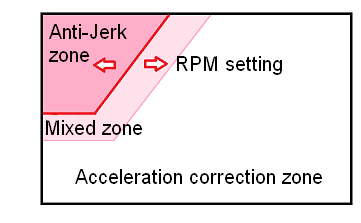
Smoothes out accelerations on low RPM. Adjust the RPM and level to achieve a smooth driving on 1st gear and low RPM.
The figure shows how settings are applied.